What is conversational AI in customer service?
Deploy conversational AI on WhatsApp for customer service in 2026 — hybrid AI + human models, containment benchmarks, industry playbooks, and how Ominiflow fits Indian SMBs and enterprises. AI-powered assistants that understand natural language, resolve routine queries, retain context across messages, and escalate to human agents with full conversation history when needed.
Last updated: 6 July 2026
Customers in 2026 expect fast responses, accurate answers, and not having to repeat themselves — on WhatsApp, email, and phone alike. When basic chatbots fail, trust erodes fast. The answer is not "more bots" or "replace humans" — it is conversational AI with graceful human handoff on the channel your customers already use daily.
For millions of businesses in India and globally, that channel is WhatsApp. This guide maps conversational AI customer service to practical WhatsApp deployments on Ominiflow — architecture, KPIs, industry playbooks, troubleshooting, and a four-step rollout plan for SMBs and enterprises.
Too long? Start here
- Conversational AI = NLP/LLM + workflow logic that understands intent, resolves tier-1 queries, and escalates with full context
- 40–60% of tier-1 queries can be automated; emotional and complex cases need humans
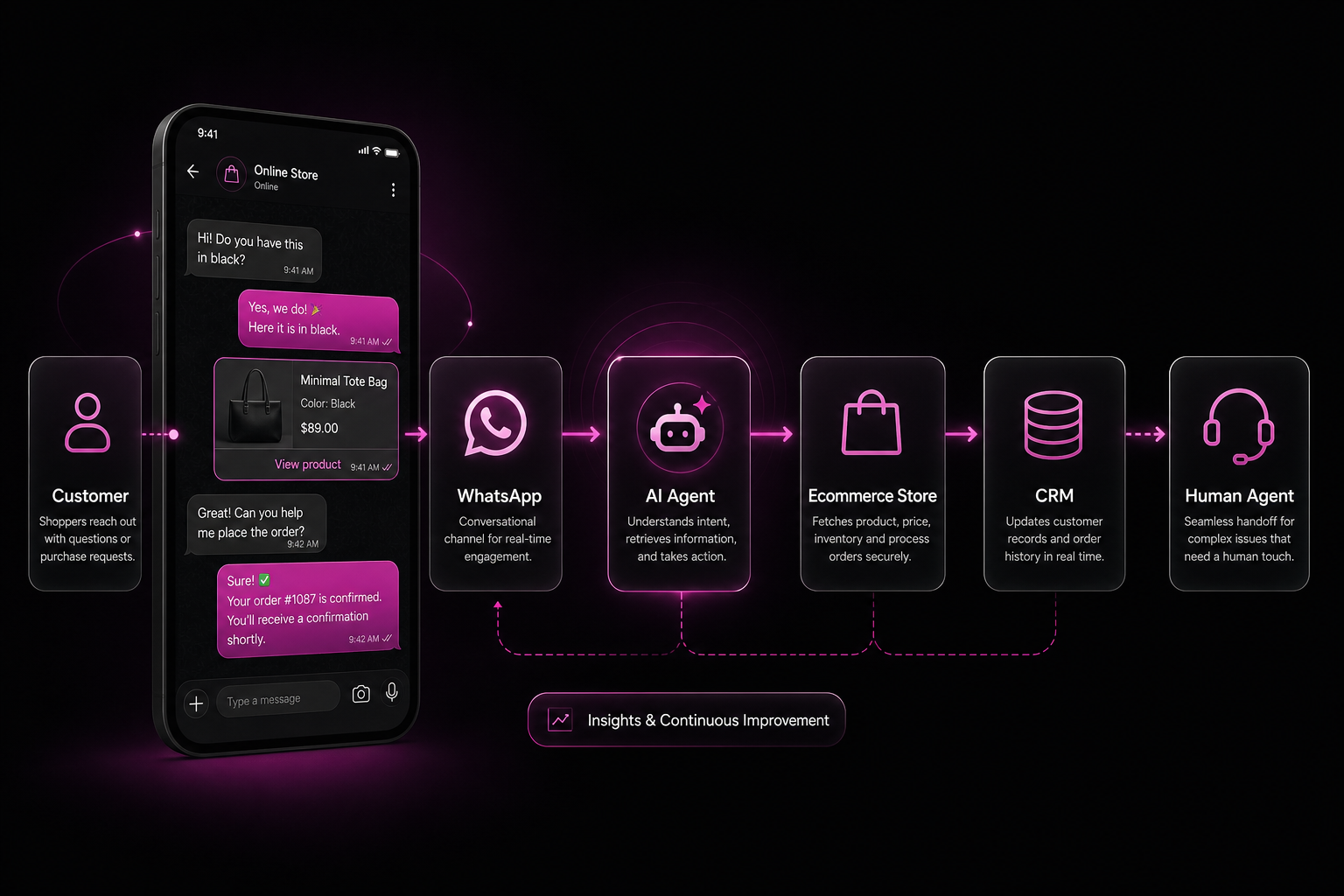
- WhatsApp stack: customer message → Cloud API webhook → AI node → template/session reply → agent inbox handoff
- Hybrid model wins: AI handles volume; agents handle judgment, refunds, complaints
- Track containment rate, FRT, CSAT, handoff quality — not just "bot live" vanity metrics
- Ominiflow: visual AI nodes + shared inbox + Zoho/Shopify sync on official Cloud API
What conversational AI in customer service actually means
Conversational AI uses natural language processing and machine learning to understand intent, extract entities (order IDs, dates, account details), and respond in natural language — then escalate with full context when needed.
Industry adoption has accelerated sharply:
- AI-powered support agent adoption rose from ~20% (2023) to ~80% (2025)
- 82% of consumers would choose a bot if it helped them like a human would
- 71% wish they could solve problems without needing a human — for routine queries
- Hybrid AI + human models boost agent productivity by up to 15% while improving outcomes
What it is not: a replacement for empathy on sensitive issues. AI handles routine volume; humans handle judgment, emotion, and complex exceptions.
Most WhatsApp programs start with workflow AI agents (rule-based + LLM nodes) before expanding to cross-system agentic orchestration. See enterprise AI agents guide.
"The teams that win treat WhatsApp like a channel in their data model — with templates, webhooks, AI containment targets, and error handling baked in from day one."
Conversational AI stack on WhatsApp
Voice platforms stack speech-to-text, intent detection, and text-to-speech for phone lines. On WhatsApp, the equivalent Ominiflow stack looks like this:
| Component | Voice AI | WhatsApp on Ominiflow |
|---|---|---|
| Input | Speech-to-text on calls | WhatsApp messages + media + voice notes |
| Intent & entities | Billing, order status, booking | AI nodes + keyword flows in visual builder |
| Routing | Warm transfer to live agent | Handoff to shared inbox with tags & context |
| Response | Voice synthesis | Template + session messages, buttons, lists |
| Post-conversation | Call summary → CRM | Chat log → Zoho CRM / webhooks / Shopify |
| Follow-up | Email, SMS | WhatsApp template nudges, CSAT surveys |
Architecture primer: WhatsApp API integration guide · Cloud API vs Business API
Cloud API context in 2026
All conversational AI on WhatsApp runs through Meta's Cloud API — the only supported path since on-premise was retired in October 2025. Your AI layer sits between your business systems and Meta:
- Customer messages your business number
- Meta delivers webhook JSON to your BSP (Ominiflow)
- AI engine classifies intent and runs flow nodes
- Reply sent via Graph API — session message (inside 24h window) or approved template (outside)
- Escalation routes to agent inbox with full thread history
Top benefits for support teams
1. Fast, accurate first response
B2B and B2C buyers rank fast response time, accurate information, and efficient resolution as top service qualities. Conversational AI on WhatsApp delivers instant replies 24/7 — critical when 66% of consumers use 3+ channels but 79% expect consistency so they never repeat themselves.
Ominiflow: AI agent answers tier-1 queries; humans pick up exceptions in the same inbox.
2. Omnichannel context — WhatsApp as the hub
Memory-rich AI (unified customer profile across touchpoints) builds deeper relationships. In India, WhatsApp often is the hub — orders, support, and payments flow through one thread.
Ominiflow: CRM sync (Zoho, Shopify, SAP via webhooks) keeps order history and lead stage visible before an agent replies.
3. Reduce agent burnout
Contact centre turnover runs 30–45% — more than double other industries. AI can auto-summarise chats, handle repetitive FAQs, and pre-authenticate customers before human join.
Ominiflow: Macros, internal notes, and AI-first routing free agents for high-value conversations.
Where conversational AI delivers most value
Intent detection and routing
Replace "Press 1 for billing" with natural language: "I need a refund for order #1234." Ominiflow routes to the right queue, tag, or specialist agent — or resolves automatically if the intent is simple.
Automate low-complexity enquiries
Industry estimates suggest 40–60% of tier-1 queries can be automated: order status, FAQs, appointment booking, password resets, return policies. Start here before expanding to complex agentic workflows.
Pre-conversation authentication
On voice, authentication can burn 45 seconds–2 minutes per call. On WhatsApp, verify via OTP template, order ID match, or CRM lookup while the customer types — agents join with identity already confirmed. Guide: OTP on WhatsApp.
Post-conversation automation
After resolution: log to CRM, send CSAT template, trigger follow-up campaign, or schedule a callback. No manual wrap-up notes required.
AI + human: who handles what
| Task | Best fit | Why |
|---|---|---|
| Routing & triage | AI | Instant intent classification and queue assignment |
| Summarising long threads | AI | Condenses chat history for the next agent |
| Simple / repetitive queries | AI | Order status, hours, tracking, FAQs |
| Complex queries | AI + Human | AI collects context; human resolves with judgment |
| Emotional or sensitive issues | Human | Empathy, refund exceptions, complaints |
KPIs that matter (not vanity metrics)
| Metric | Target range | What it tells you |
|---|---|---|
| Containment rate | 40–65% tier-1 | % resolved without human — primary AI ROI signal |
| First response time (FRT) | <30 seconds AI; <5 min human | Speed perception drives CSAT |
| Handoff quality score | Agent rates context 4+/5 | Bad handoffs waste both AI and agent time |
| CSAT post-chat | 4.0+/5.0 | Track separately for AI-only vs human-resolved |
| Drop-off by flow node | Identify >20% abandon points | Fix confusing copy or missing fallback paths |
| Escalation rate | 35–60% initially | Should decrease monthly as intents expand |
Industry examples on WhatsApp
Full industry guide: WhatsApp AI industry use cases (2026).
Banking & financial services (BFSI)
- Balance enquiries, transaction alerts, loan status
- OTP and secure authentication templates
- Lead qualification for NBFC and insurance products
- EMI reminders and payment link templates
Fintech deep dive: loan application flows
Healthcare
- Appointment booking, rescheduling, and reminders
- Prescription refill requests (non-diagnostic)
- Clinic hours, insurance, and lab report notifications
- Human escalation for clinical questions — never diagnose via bot
Retail & e-commerce
- Order tracking, returns, COD confirmation
- Abandoned cart recovery (Shopify integration)
- Product catalog, recommendations, and festival campaigns
Case study: D2C skincare brand, 8,400 support chats/month
- Stack: Shopify order webhooks → Ominiflow AI nodes → Cloud API → shared inbox
- Timeline: Week 1–2 intent mapping; Week 3 pilot 20% traffic; Week 6 full rollout
- Intents automated: Order status, return policy, delivery ETA, product ingredient FAQ
- Results after 90 days: 52% containment rate, FRT dropped from 4.2 min to 18 sec (AI path), CSAT 4.3/5
- Lessons learned: Hindi-English mixed queries needed separate training examples; "talk to human" button reduced frustration escalations by 31%
Ominiflow rollout playbook (4 steps)
- Define purpose — pick 3–5 intents (order status, returns, booking, FAQs). Document expected containment target per intent.
- Configure flows — visual builder + AI nodes + CRM/webhook connections. Add explicit "speak to agent" fallback on every branch.
- Test — pilot 20% of inbound traffic; review failed handoffs daily for 2 weeks. Test Hinglish typos and voice-note inputs.
- Deploy & monitor — track containment, FRT, CSAT; expand intents monthly. Kill underperforming branches.
Troubleshooting common failures
| Symptom | Likely cause | Fix |
|---|---|---|
| AI loops on same question | Missing fallback node | Add "I didn't understand → agent" path after 2 failed attempts |
| High escalation rate (>70%) | Intents too broad or training gaps | Narrow scope; add FAQ upload for product-specific answers |
| Agents complain about context | Handoff missing chat summary | Enable AI thread summary on escalation node |
| CSAT drops after AI launch | Over-automation on emotional intents | Route refund/complaint keywords directly to human |
| Order lookup fails | Webhook timeout or wrong order ID format | Queue API calls async; validate ID regex in flow |
Related resources
- WhatsApp AI agent for business
- Enterprise AI agents on WhatsApp (2026)
- Ominiflow vs Yellow.ai
- WhatsApp customer support inbox
- Ominiflow pricing
FAQ
What is conversational AI in customer service? expand_more
AI that understands natural language, resolves routine issues, retains context, and hands off to humans with full chat history — on chat, voice, or messaging channels like WhatsApp.
Will conversational AI replace support agents? expand_more
No. Hybrid models automate 40–60% of tier-1 volume so agents focus on complex, emotional, and high-value interactions. Headcount may shift but not disappear.
Why WhatsApp for conversational AI in India? expand_more
India has one of the world's largest WhatsApp user bases. Customers expect instant replies on WhatsApp for orders, support, and payments — often preferring it over phone or email.
How is Ominiflow different from Retell AI or Yellow.ai? expand_more
Retell is voice-first; Yellow.ai is enterprise omnichannel. Ominiflow is WhatsApp-native with published pricing, shared inbox, native Zoho connectors, and India/UAE/USA onboarding support.
What containment rate should I target? expand_more
Start at 30–40% in month one; mature programs hit 50–65% on tier-1 intents. Complex BFSI or healthcare programs may target lower containment with higher handoff quality.
Do I need the WhatsApp Business API for conversational AI? expand_more
Yes for scalable business deployments. The free WhatsApp Business App cannot run multi-agent AI, CRM sync, or template-based proactive outreach at volume.
Can conversational AI handle Hindi and Hinglish? expand_more
Yes. Configure flows and AI training in Hindi, English, or Hinglish — match your audience. Test with real mixed-language inputs before full rollout.
Deploy conversational AI on WhatsApp
Start with tier-1 automation, keep humans in the loop, and scale on the channel customers already trust.
Updated July 2026. Conversational AI customer service guide for WhatsApp — verified against Meta Cloud API documentation and Ominiflow production deployments.