What is WhatsApp marketing software?
WhatsApp marketing software for Indian brands: lifecycle campaigns, segmentation, templates, analytics, CRM sync, and ROI benchmarks — built on WhatsApp Business API Cloud API. A platform that connects to WhatsApp Business API for template management, segmentation, broadcasts, behavioural automation, reply handling, and campaign analytics.
Last updated: 6 July 2026
WhatsApp marketing software is the layer between your customer data and the WhatsApp Business API — it handles template approval, audience segmentation, campaign scheduling, reply routing, and revenue attribution. Without it, you're either blasting from a personal number (risky) or duct-taping Zapier zaps that fail silently at scale. Product overview: Ominiflow WhatsApp marketing software.
This guide explains what real WhatsApp marketing software does, how it differs from bulk SMS tools and the free Business App, what features Indian growth teams should evaluate, pricing models, ROI benchmarks, and how Ominiflow stacks up for D2C, B2B, and agency use cases on Meta's Cloud API.
Too long? Start here
- WhatsApp marketing software = API access + template manager + segmentation + broadcasts + inbox + analytics
- Requires WhatsApp Business API — consumer app cannot run compliant marketing at scale
- Marketing messages need approved templates and documented opt-in
- Top ROI flows: cart recovery, drop alerts, win-back, festive campaigns, referral prompts
- Benchmark: 98% open rate, 11% journey CTR vs 2.6% unsegmented broadcasts — 2026 marketing benchmark
- India marketing conversations ₹0.86 per 24-hour window (verify Meta rate card)
What is WhatsApp marketing software?
It's a platform (BSP) that lets marketing teams send, schedule, and measure WhatsApp campaigns programmatically. Core capabilities:
- Template management — create, submit, track Meta-approved marketing/utility templates
- Audience segmentation — tags, purchase history, CRM stages, opt-in source
- Broadcast campaigns — schedule sends to thousands of opted-in contacts
- Behavioural automation — triggered journeys (cart abandoned, 30 days lapsed)
- Two-way inbox — agents handle replies from the same platform
- Analytics — delivery, read, click, reply, and revenue attribution
Compare: WhatsApp Business API vs Business App
WhatsApp marketing vs SMS and email
| Channel | Open rate | Two-way | Rich media | India DND issues |
|---|---|---|---|---|
| ~98% | Yes | Images, carousels, buttons | No (with opt-in) | |
| SMS | ~90% (but ignored) | No | Text only | Yes — promotional DND |
| 15–20% | Limited | Yes | Spam filters |
Ominiflow benchmark data shows 3× email ROI and 85% higher reply rates vs SMS on comparable campaigns.
Features to evaluate
1. Template and compliance tooling
Can you create marketing templates, track approval status, and map variables without developer help? Rejected templates delay campaigns — good software surfaces rejection reasons and suggests fixes. Guide: template API guide
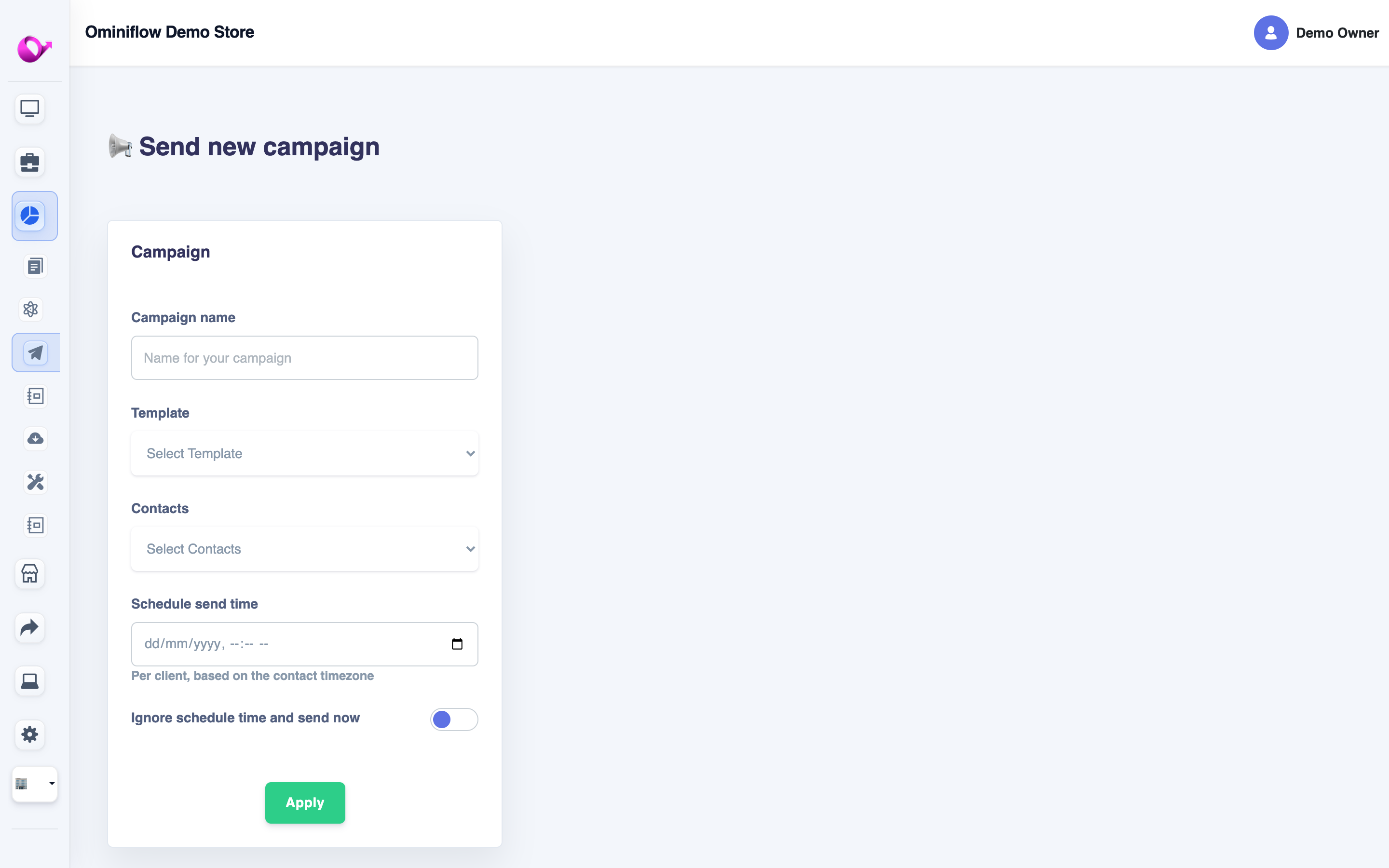
Schedule a broadcast — pick an approved template, select a contact segment, and send now or schedule per timezone.
2. Segmentation and cohorts
First-time vs repeat buyers, AOV tiers, category tags, days since last purchase, festival cohorts. Broadcasting to your full list is how accounts get blocked.
3. Automation builder
Visual workflows for cart recovery, order lifecycle, win-back. Native automation has fewer failure points than iPaaS chains. Guide: automation platform.
4. CRM and store integrations
Shopify, Zoho, WooCommerce sync for product images, order events, and contact fields. Native connectors beat Zapier for core revenue workflows.
5. Shared inbox for reply handling
Marketing CTR is worthless if nobody answers when the customer replies. Unified inbox: inbox benefits guide.
6. Analytics and attribution
Track revenue per campaign, not just sends. Connect to Shopify or CRM for closed-loop reporting.
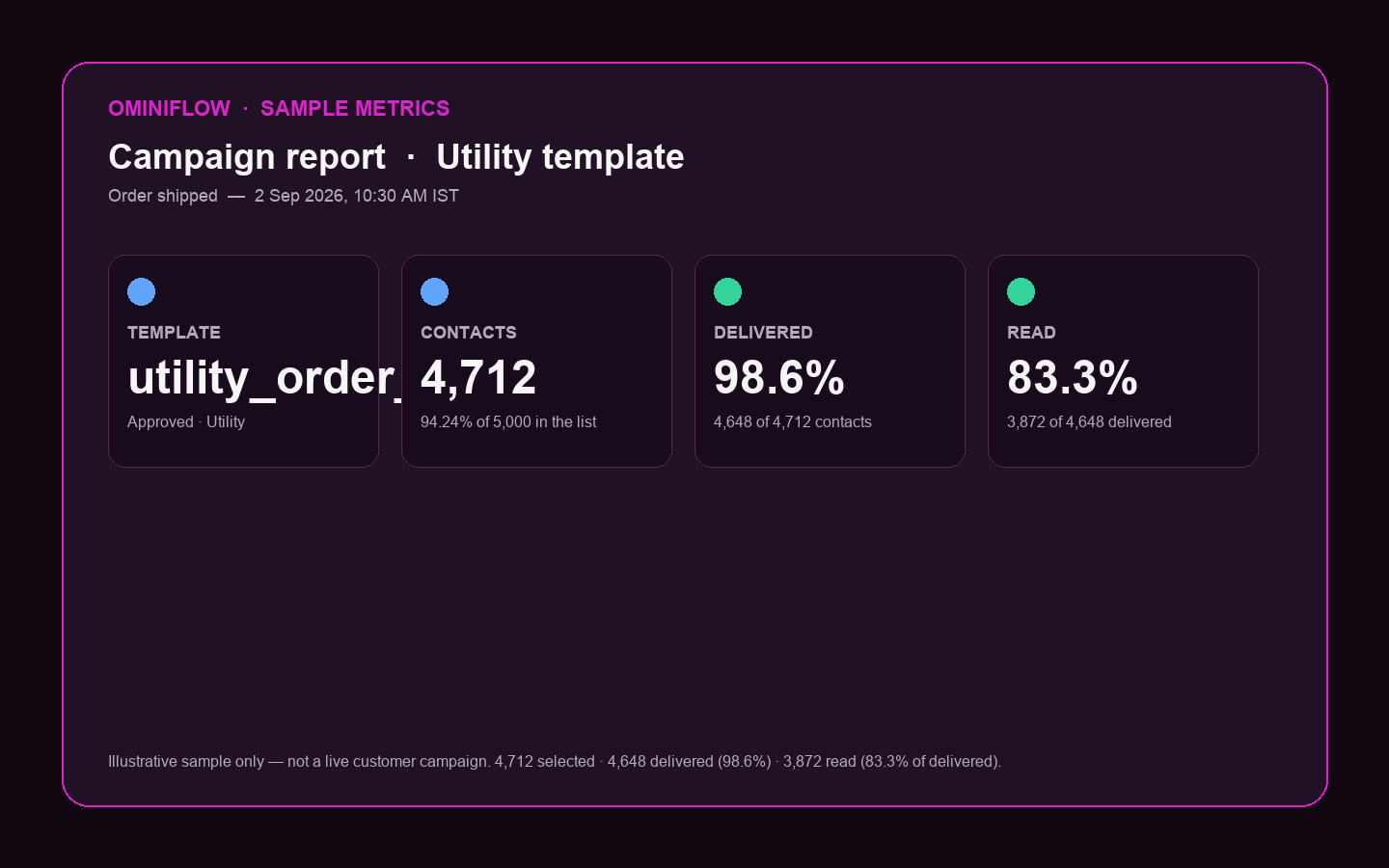
Campaign analytics — template used, contacts reached, delivery %, and read rate per broadcast.
High-ROI campaign playbook
| Campaign | Category | Timing | Typical result |
|---|---|---|---|
| Abandoned cart | Marketing (opt-in) | 1h, 24h after abandon | 12–28% recovery |
| Post-purchase cross-sell | Marketing | 7 days after delivery | 8–12% attach rate |
| Festival sale | Marketing | T-3 days, day-of | 35–55% read rate |
| Win-back (90 day lapsed) | Marketing | Single send + 48h follow-up | 5–9% reactivation |
| COD confirmation | Utility | Within 5 min of order | 20–40% RTO reduction |
Bulk guide: compliant bulk messaging
Use cases by industry
E-commerce / D2C: VIP early access, festive campaigns, cart recovery. D2C brands guide.
Fashion: Drop alerts, fit follow-ups. fashion retention.
Healthcare: Appointment reminders, wellness nudges (utility templates).
Education: Enrollment pushes, webinar invites.
Real estate: New inventory alerts via click-to-WhatsApp ads.
B2B services: Nurture sequences, proposal follow-ups, renewal reminders.
Mistakes that kill ROI
- Over-messaging — more than 1–2 marketing messages per week to cold segments
- Poor segmentation — same offer to VIPs and one-time bargain hunters
- No reply workflow — broadcast without agents or bots ready
- Missing opt-in proof — Meta restricts accounts without consent logs
- Utility templates for promos — category mismatch triggers rejection and bans
Ban prevention: account restriction guide
Why Ominiflow for WhatsApp marketing
- Marketing + support + automation in one workspace — no tool sprawl
- Native Zoho and Shopify connectors — no Zapier tax on core flows
- Flat pricing without per-contact tier traps at scale
- Meta fees passed at cost — transparent invoice
- India, UAE, USA onboarding with template guidance
Compare: Ominiflow vs WATI · choose the right platform
Pricing model
Total cost = platform fee + Meta per-conversation charges. India marketing conversations ₹0.86 each. Model before budgeting: 50,000-contact Diwali campaign ≈ ₹43,000 in Meta fees if every contact opens a new window.
Details: pricing · API pricing guide · TCO calculator
FAQ
Is WhatsApp good for marketing in India? expand_more
Often yes — with opt-in and relevant messaging it delivers 98%+ open rates. It's the highest-attention channel for Indian consumers when used as lifecycle CRM, not spam.
How is WhatsApp marketing software different from SMS tools? expand_more
Richer interactions, two-way engagement, images/buttons/carousels, and conversation-based pricing — all within Meta's template and opt-in rules.
Can we personalize WhatsApp marketing messages? expand_more
Yes, within template variable limits ({{1}}, {{2}}). Dynamic product names, order IDs, and customer names are standard.
What mistakes hurt WhatsApp marketing ROI? expand_more
Over-messaging, poor segmentation, weak post-click handling, and missing opt-in documentation.
Do you support agencies managing multiple brands? expand_more
Yes — multi-workspace controls with client isolation and separate WABAs per brand on supported plans.
How do we measure WhatsApp marketing success? expand_more
Delivery/read rates plus downstream metrics: CTR, reply rate, conversion, and revenue attributed in Shopify or CRM.
Do marketing messages need template approval? expand_more
Yes. All business-initiated marketing messages outside the 24-hour customer service window require Meta-approved templates.
Which tool is best for WhatsApp marketing? expand_more
The best WhatsApp marketing tool is the one that sends only to opted-in contacts, keeps marketing templates in the marketing category, and shows which campaign produced the reply. For Indian teams that also need Shopify or Zoho, that is Ominiflow on Cloud API — broadcasts, automation, and a shared inbox on one number. A broadcast-only app is enough only if you never need the reply in a CRM. Updated July 2026. WhatsApp marketing software guide for Indian growth teams — verified against Ominiflow product capabilities and Meta Business Platform policies.

